
Want more wrestling news, rumors, and results? Be sure to visit PWInsider.com and PWInsiderXtra.com.
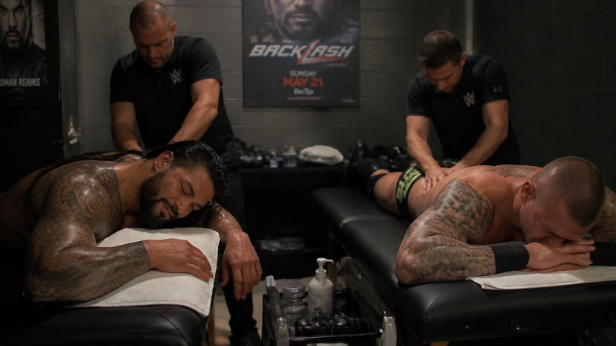
A wrestling ring is not a trampoline. It is a steel frame, wooden boards, a thin layer of padding, and a canvas stretched over the top. Every flat back bump sends a shock up through the shoulder blades and into the base of the skull, and a working talent on a full schedule will take somewhere between fifteen and forty of them in a night.
Multiply that across a touring calendar. Television, house shows, independent bookings on the off days, international loops, and the drives in between. The number that gets quoted around locker rooms is 200 dates a year, and while the top of the card sees fewer of those now than it did in the territory era, the mid-card grind on the independent circuit has arguably gotten worse. The bookings are spread across more promotions and more countries than ever.
The bodies holding up under that schedule are not doing it on adrenaline alone. Recovery work has quietly become one of the most serious line items in a working wrestler's budget, and the way that money gets spent has changed considerably in the last fifteen years.
Broken bones and torn ligaments get reported. The problems that actually end careers rarely do.
What accumulates instead is soft tissue damage: chronically shortened hip flexors from constant sitting in cars and planes, thoracic spines that have lost most of their rotation, rotator cuffs asked to stabilise a body being thrown at a turnbuckle, and neck musculature doing quiet overtime to protect a cervical spine that has absorbed a decade of impact. None of it shows up on a report. All of it compounds.
Add dehydration from travel, sleep fragmented across time zones, and a training schedule that continues regardless, and the result is a body in a permanent state of partial repair. The performers who last are usually the ones who worked out early that recovery is not something done after the injury. It is the thing that delays the injury.
The default assumption is that a wrestler wants the hardest possible massage. Plenty do, and there is a place for it, but the timing is what separates useful treatment from an extra day of soreness.
Aggressive deep tissue work, active release, and trigger point therapy all create a small amount of controlled inflammation. Scheduled forty-eight hours before a match, that is fine and often helpful. Scheduled the morning of a show, it can leave a performer flat, sore, and slightly slower in the ring, which is where mistakes happen. Experienced road veterans tend to book the heavy work at the start of a loop and keep the day-of treatment light.
The evidence base for massage in athletic recovery is more modest than the marketing suggests, and worth understanding honestly. Reviews summarised by the National Center for Complementary and Integrative Health point to reasonably consistent findings for pain and perceived recovery, and much weaker findings for things like lactate clearance, which was the old justification. The pain and function results are the ones that matter for someone who has to work again in eighteen hours.
Ask a wrestler what wrecks them and the answer is usually not the match. It is the eleven-hour drive afterwards.
Long periods in a fixed seated position shorten the hip flexors and lock the thoracic spine, which then forces the lumbar spine and shoulders to compensate during the next night's bumps. That compensation pattern is where a large share of chronic lower back complaints originate. A foam roller in a hotel room helps at the margins. It does not restore rotation to a segment of spine that has not moved properly in three weeks.
This is where hands-on assessment earns its fee. A competent therapist finds the segment that has stopped contributing, works the surrounding tissue, and gives the performer two or three specific things to do in the car. The Mayo Clinic lists massage among the reasonable options for managing muscle tension and stress-related symptoms, and for a population whose stress and physical load arrive in the same package, that combination is the relevant one.
Here is the part that gets underrated. A wrestler coming off a main event is running on a fully activated sympathetic nervous system: elevated heart rate, high cortisol, senses sharpened by adrenaline. That state does not switch off because the show ended. It follows the performer into the hotel, keeps them awake until four, and starts the next day at a deficit.
Chronic under-recovery of that kind does more long-term damage than any single bad landing. Sleep debt slows tissue repair, blunts reaction time, and raises injury risk in a job where a split second of hesitation can mean a badly received move.
Which is why the sharper performers now schedule at least some treatment that is not about breaking up scar tissue at all. Slow, warm, full-body work with sustained pressure and no sharp elbows is aimed squarely at the parasympathetic response, and its purpose is to get an over-revved athlete back down to a baseline where actual repair can happen. At that end of the spectrum sit the whole-body traditions, including studios offering tantric massage in cities like London where touring talent frequently has a night off between dates. Whatever the label, the mechanism is the same: unhurried contact, controlled breathing, and a session long enough for the body to stop bracing.
Talent who have built a sustainable system tend to follow a rough pattern rather than a rigid plan.
Heavy soft tissue work early in a loop, never the day of a big match.
Light flushing work or self-treatment on show days, kept short.
One longer, slower session per week or per tour block aimed at sleep and nervous system recovery rather than muscle.
Hydration and actual sleep treated as training, not as luxuries.
The performers who ignore all of this often get away with it for a while. The bill tends to arrive somewhere around year eight, and it is usually presented in the form of a neck.
Professional wrestling has never been generous to bodies, and no amount of bodywork changes what happens when someone lands wrong. What it does change is the slower attrition: the stiffness that becomes a limp, the tight shoulder that becomes a torn cuff, the sleepless tour that becomes a season of diminished performances.
The talent still going strong deep into their careers are rarely the toughest ones in the locker room. They are usually the ones who booked the appointment, took the light session when they wanted the hard one, and treated recovery as part of the job rather than a reward for surviving it.
If you enjoy PWInsider.com you can check out the AD-FREE PWInsider Elite section, which features exclusive audio updates, news, our critically acclaimed podcasts, interviews and more by clicking here!